Updated: October 5, 2026
What is an explosive atmosphere?
An explosive atmosphere is one in which a flammable gas, vapour, mist or dust mixes with air and can be ignited by a source of ignition. Paint and solvent lines, chemical plants, refineries, fuel storage areas, flour and feed mills and lines that handle dust are typical examples.
For an explosion to occur, a flammable substance, oxygen and an ignition source must be present at the same time. Electrical equipment can become an ignition source in two ways: through sparks or arcs, and through hot surfaces. The second risk is especially important for heaters, because a heater's job is precisely to heat its surface.
The difference between explosion-proof and ATEX
Explosion-proof (often shortened to Ex-proof) is a widely used term meaning protected against explosion. In technical language it usually refers to the flameproof enclosure (Ex d), which contains any explosion that may occur inside it and prevents ignition of the surrounding atmosphere. In everyday use, however, it is applied to any equipment suitable for an explosive atmosphere.
ATEX, by contrast, is not a protection method but the European Union's regulatory framework for explosive atmospheres. Its name comes from the French "ATmosphères EXplosibles", and it is based on two directives:
- 2014/34/EU: Requirements for manufacturers and conformity assessment for equipment and protective systems intended for use in explosive atmospheres.
- 1999/92/EC: The employer's duty to assess explosive atmosphere risk, classify areas into zones and protect workers.
In Türkiye these directives have been transposed into national law through the corresponding regulations. Outside Europe, the widely used international certification system is IECEx; in both systems the technical requirements are largely based on the IEC/EN 60079 series of standards. In short, explosion-proof describes a protection feature, while ATEX describes the rules under which that feature is assessed.
Hazardous area zone classification
The plant operator classifies areas into zones according to how often and for how long an explosive atmosphere is likely to occur. This classification is usually set out in the plant's explosion protection document.
- Zone 0 / Zone 20: An explosive atmosphere is present continuously, for long periods or frequently; for example, inside a tank.
- Zone 1 / Zone 21: An explosive atmosphere is likely to occur occasionally in normal operation.
- Zone 2 / Zone 22: An explosive atmosphere is not expected in normal operation; if it does occur, it persists only briefly.
Zones 0, 1 and 2 are used for gas, vapour and mist; Zones 20, 21 and 22 for combustible dust. The corresponding equipment categories are 1, 2 and 3. The same distinction is also expressed as the equipment protection level (EPL) in the form Ga/Gb/Gc and Da/Db/Dc.
Gas and dust groups
Equipment groups are divided according to the type of atmosphere: Group I is for mining (firedamp), Group II for gases and vapours, and Group III for dust atmospheres. Groups II and III are further divided into subgroups:
- IIA: Gases that are relatively difficult to ignite, such as propane.
- IIB: Gases in the intermediate group, such as ethylene.
- IIC: The most easily ignited gases, such as hydrogen and acetylene. Equipment suitable for IIC can also be used in IIB and IIA atmospheres.
- IIIA is used for combustible flyings, IIIB for non-conductive dust and IIIC for conductive dust.
The higher the group, the stricter the requirements for enclosure and connection design. The group of the substance present is obtained from the plant's explosion protection document and the substance's safety data sheet.
Temperature classes: T1–T6
The temperature class indicates the highest temperature that can occur on any surface of the equipment in contact with the atmosphere. This value must remain below the auto-ignition temperature of the gas or vapour present.
- T1: maximum 450 °C
- T2: maximum 300 °C
- T3: maximum 200 °C
- T4: maximum 135 °C
- T5: maximum 100 °C
- T6: maximum 85 °C
For dust atmospheres, a temperature is stated directly instead of a class, for example T135 °C. This value is assessed against the ignition temperature of both the dust cloud and the dust layer that accumulates on the surface.
For heaters, the temperature class is a decisive design criterion. When a lower limit is required (for example T4 instead of T3), the permissible element surface temperature falls. This means a lower watt density, a longer heater and additional temperature-limiting measures.
How to read the Ex marking
The label of equipment for explosive atmospheres gives this information in a short code. A typical marking for a gas atmosphere is: CE XXXX · Ex · II 2 G · Ex db IIC T4 Gb
- CE XXXX: The CE marking and the number of the notified body involved in production surveillance.
- Ex (in a hexagon): The specific marking for equipment for explosive atmospheres.
- II 2 G: Group II (surface industries), category 2 (suitable for Zone 1), G (gas).
- Ex db: Type of protection; here, flameproof enclosure.
- IIC: Gas group.
- T4: Temperature class; maximum surface temperature 135 °C.
- Gb: Equipment protection level.
The equivalent for a dust atmosphere takes the form "II 2 D Ex tb IIIC T135 °C Db"; D indicates a dust atmosphere and Ex tb indicates dust protection by enclosure. Other types of protection used in heaters include increased safety (Ex e) and pressurisation (Ex p). A product may carry more than one type of protection at the same time.
Selecting a heater for a hazardous area
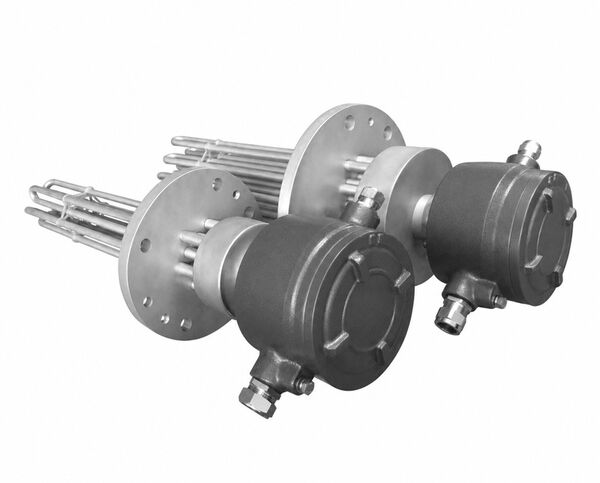
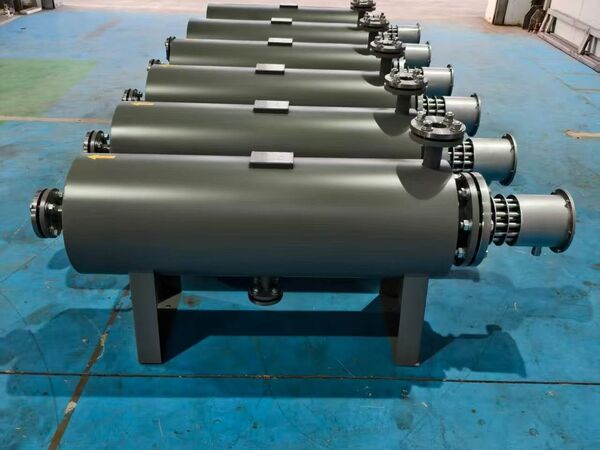
Explosion-proof heaters usually consist of tubular or flanged heating elements combined with a terminal enclosure suitable for the explosive atmosphere and a temperature-limiting system. Selection follows this sequence:
- Determine the plant's zone classification.
- Determine the gas or dust group and the ignition temperature of the substance present.
- Select the required temperature class.
- Define the medium to be heated, the power, the voltage and the mounting method.
- List the certification and documentation requirements (declaration of conformity, certificate, operating instructions) according to the project specification.
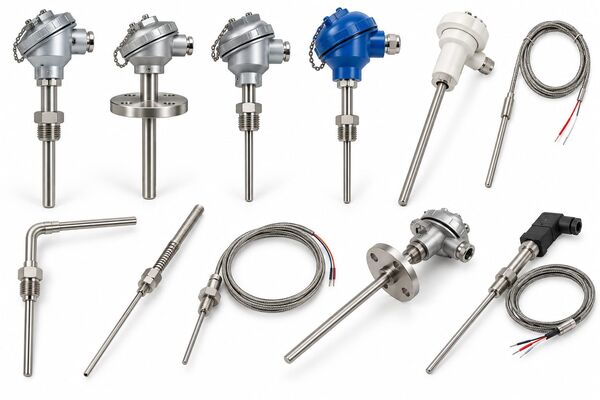
The heater's surface temperature must be limited not only in normal operation but also under fault conditions. A falling liquid level in an immersion heater, or a stopped fan in an air heater, quickly raises the element temperature. For this reason, level control, flow monitoring and an independent temperature limiter working from a sensor fitted to the element are treated as part of the design. For sensor options, see the thermocouples, temperature sensors and connectors page.
Project-specific certification and documentation requirements are clarified at the quotation stage. Sharing the zone, group and temperature class in your enquiry makes it easier to assess the appropriate design and certification scope.
Frequently Asked Questions
No. Explosion-proof describes a protection feature, most often the flameproof enclosure. ATEX is the European Union's legislation on equipment for explosive atmospheres and workplace safety. Whether an explosion-proof product can be used on the EU market depends on it passing conformity assessment under ATEX.
In a gas atmosphere, Zone 1 requires at least category 2G (EPL Gb) equipment. Category 1G equipment can also be used in Zone 1, whereas category 3G equipment is suitable for Zone 2 only.
The zone classification, gas or dust group, required temperature class, medium to be heated, power and voltage, mounting method (flange, screw plug) and the required certification scope. Most of this information can be found in the plant's explosion protection document.