
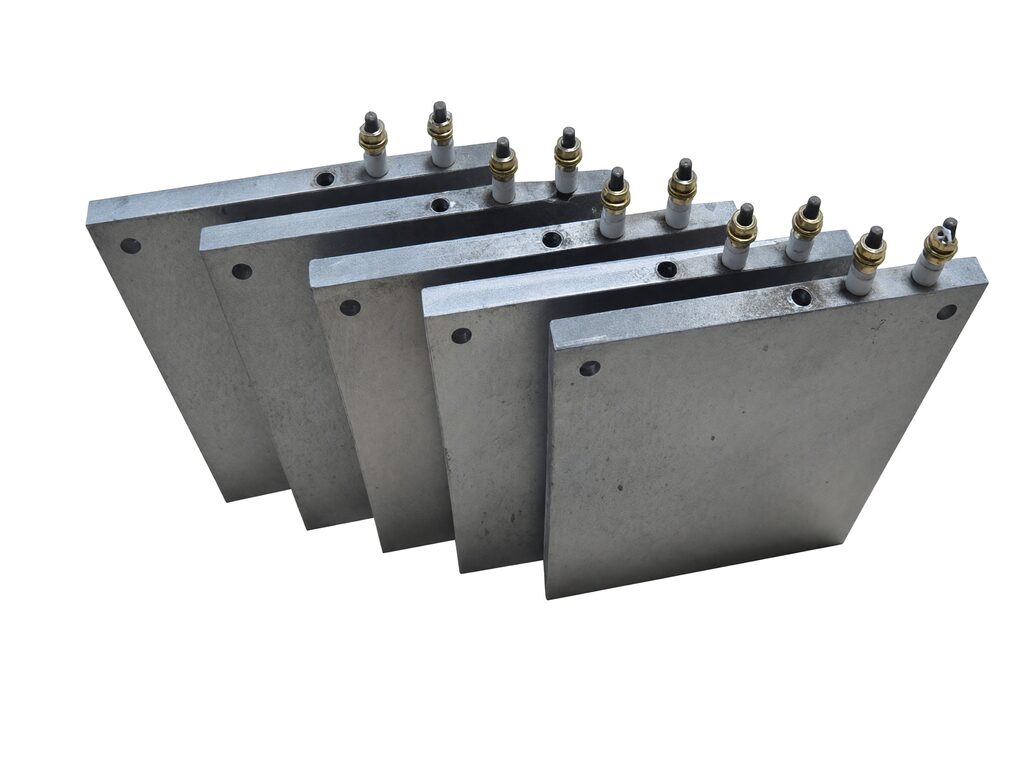
Made by casting a tubular heater into an aluminium or brass body; provides even heat distribution across a large surface.
Also known as: Cast-in heater · Cast aluminium heater
You can upload your technical drawing via the quote form.
General Information
A cast-in aluminium heater is made by first bending a tubular heater to shape, placing it in a mould and casting aluminium around it. The result is a heater completely embedded in the metal mass, with no air gap left in between. This construction provides the highest heat transfer efficiency achievable in contact heating.
The second advantage of the cast body is its thermal inertia. The metal mass behaves like a heat reservoir; when the heater switches off the temperature does not drop suddenly, and when it switches on there is no sudden spike. This is a clear benefit in processes sensitive to temperature fluctuation.
The body can be produced as a plate, cylinder, band or in a custom shape to the customer's drawing. After casting, the surface is milled, the required holes are drilled and the sensor pocket is machined. The aluminium body operates safely up to 350 °C; where higher temperatures are required, brass or bronze casting is recommended.
Applications
- Press plates
- Mould heating
- Sealing jaws
- Lamination
- Extrusion barrels
Related Industries
Frequently Asked Questions
Mould preparation and the casting process add cost. In return, heat transfer efficiency, temperature uniformity and service life are significantly higher; the total cost of ownership is lower in most applications.
Yes. However, because the casting mould is made for the first production run, the unit cost of a single piece is high; when the same product is reordered, the unit price drops significantly.
Related Guides
Related Products
Let us define the right solution for your project together
Contact us to determine the most suitable heater and industrial heating solution for your project. Our technical team is ready to offer the solution that best fits your requirements.