
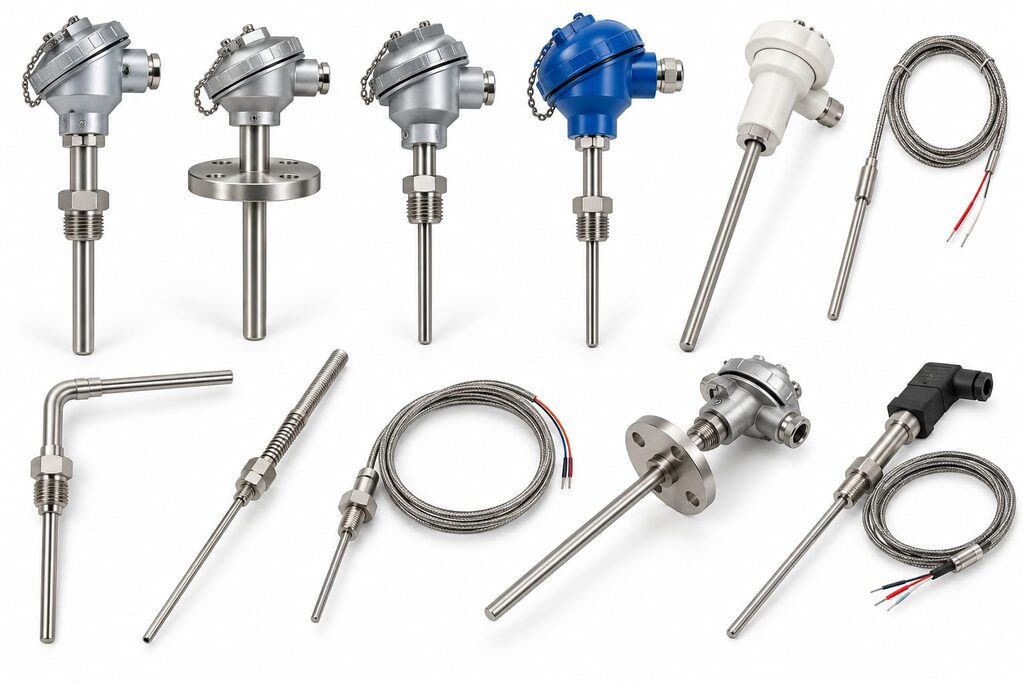
Temperature sensors used together with heaters; produced with rod, adhesive, spring-loaded and threaded body options.
Also known as: Thermocouple · Type J thermocouple · Type K thermocouple · PT100 · RTD sensor · Thermocouple connector · Termokupl
You can upload your technical drawing via the quote form.
General Information
Temperature sensors are the eyes of a heating system. A sensor that is incorrectly positioned or of the wrong type either overheats the system continuously or never lets it reach the target temperature. Buying the sensor together with the heater from a supplier who knows the same application therefore eliminates the mismatches frequently seen in the field.
The type is selected according to measuring range and accuracy. Type J (iron-constantan) is an economical solution up to 750 °C and the standard in the plastics processing industry. Type K (NiCr-Ni) reaches up to 1100 °C and is used in furnaces and high-temperature applications. The PT100 resistance thermometer gives the highest accuracy and repeatability below 400 °C.
The body type is determined by the mounting location: rod type for mould bores, spring-loaded type that presses against the barrel surface, threaded type for pipelines and adhesive type for bonding to surfaces are produced as standard. The cable material is selected according to operating temperature, with fibreglass, silicone or stainless steel braid protection. Type K and J thermocouple plugs and PT100 plugs are also supplied for the connection between the sensor and the cable or device; because the contact material of thermocouple plugs is the same as the sensor type, no measurement drift occurs at the connection point.
Applications
- Mould temperature measurement
- Barrel measurement
- Furnaces
- Tanks
- Pipelines
- Air ducts
Related Industries
Frequently Asked Questions
Type J is common and economical for moderate-temperature applications such as plastics processing. Type K is preferred for higher temperatures, such as furnaces and heat treatment. The input type of your existing controller is also decisive — if a type K sensor is connected while the controller is set to J, the reading will be wrong.
Yes. If ordinary copper cable is used in the thermocouple extension, a new thermocouple junction forms at the connection point and the measurement drifts. Extensions must always be made with compensation cable matching the sensor type.
Related Guides
Related Products
Let us define the right solution for your project together
Contact us to determine the most suitable heater and industrial heating solution for your project. Our technical team is ready to offer the solution that best fits your requirements.