
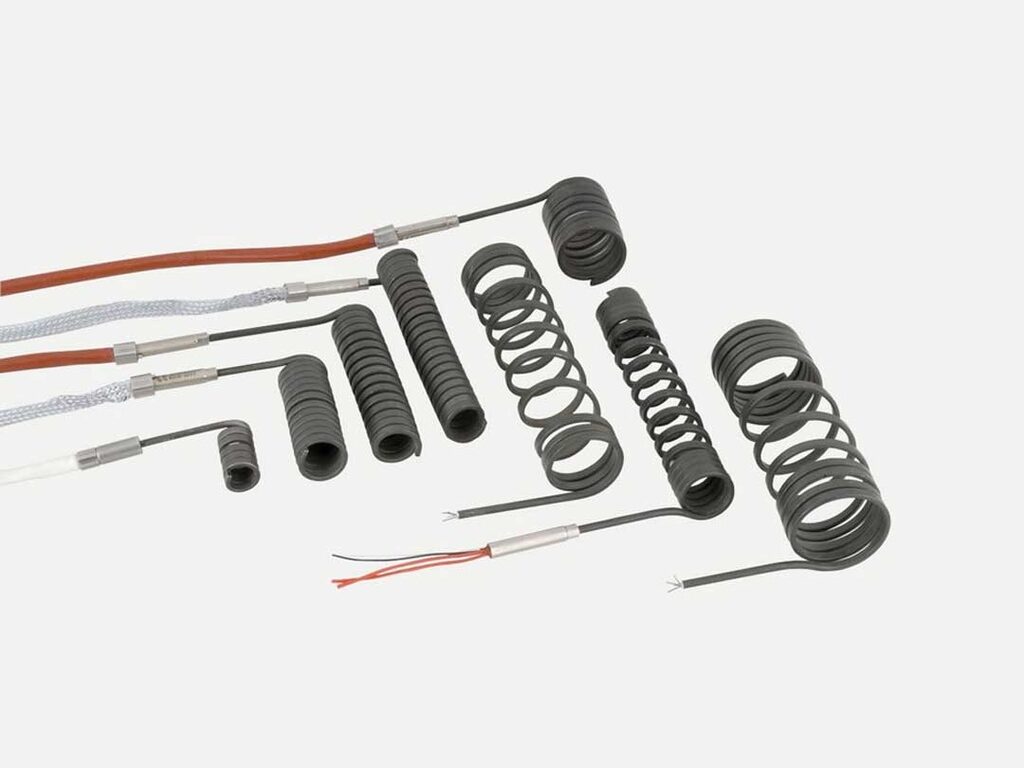
Square-section coil heaters wound directly onto hot runner nozzles and manifold bodies, together with nozzle heaters for injection machine nozzles: thin band or coil-form heaters that deliver high power in a short length.
Also known as: Coil heater · Hot runner coil heater · Hot runner heater · Nozzle heater · Nozzle band heater
You can upload your technical drawing via the quote form.
General Information
A coil heater is made by producing resistance wire placed inside a rectangular-section sheath in a flexible structure, so that it can be coiled to the required diameter. In hot runner systems it is wound directly onto the nozzle body for gap-free contact; it therefore works more efficiently than a band-type heater of the same power. The advantage of the square section is contact area: a round section touches the body only along a tangent line, whereas a flat-faced section makes contact across its full width, so heat transfer increases, the heater surface temperature drops and service life is extended.
A nozzle heater heats the nozzle area of an injection moulding machine, between the mould and the barrel, and is very short in length relative to its diameter. Because the nozzle touches the mould it loses heat continuously, so the power required per unit area is significantly higher than on the barrel. The product is manufactured as a thin mica insulated band or in a tightly wound coil form: the coil form wraps fully around the nozzle surface even on irregular geometries, while the band form offers higher mechanical strength and easy installation.
The power distribution of both products can be adjusted. By varying the winding pitch, the winding is tightened in the end zone close to the mould, where heat loss is greatest, and spaced out in the middle of the body; this produces a uniform temperature profile along the nozzle.
Temperature control in the nozzle area is critical: too low a temperature causes the material to freeze and block the nozzle, while too high a temperature causes degradation and drooling. For this reason our coil and nozzle heaters can be produced with an integrated type J or K thermocouple; the sensor is placed at the mid-length of the heater to measure the true nozzle temperature.
Applications
- Hot runner nozzles
- Manifold bodies
- Injection nozzles
- Mould inlets
- Small-diameter moulds
- Dosing nozzles
Related Industries
Frequently Asked Questions
Because the coiling process directly affects heater life, we recommend having it delivered already coiled to the required diameter in production. Forced coiling in the field crushes the sheath and damages the internal insulation.
It means varying the winding pitch along the heater so that more power is delivered to certain zones. The winding is tightened in the end zones where heat loss is high, so a uniform temperature is achieved along the nozzle.
Because the nozzle area touches the mould, it loses heat continuously and the heater stays switched on longer; its watt density is also high. Choosing the correct thermocouple position and maintaining clamping force significantly extends service life.
The sensor should be placed at the mid-length of the heater, in contact with the nozzle body. A measurement close to the ends reads below the true temperature, and the system then overheats continuously.
Related Guides
Related Products
Let us define the right solution for your project together
Contact us to determine the most suitable heater and industrial heating solution for your project. Our technical team is ready to offer the solution that best fits your requirements.