
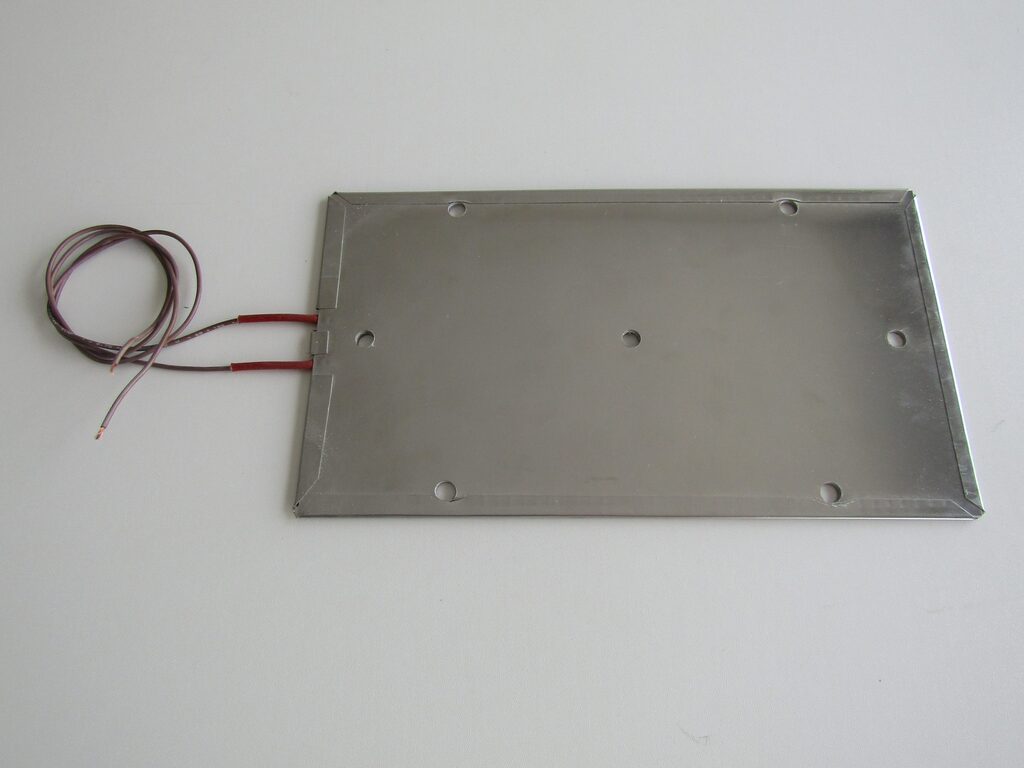
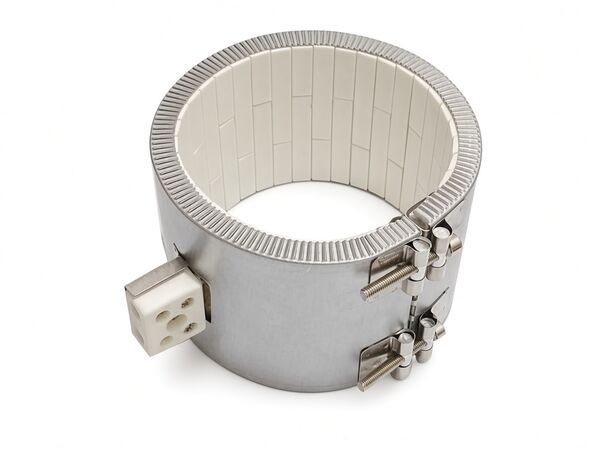
Ribbon resistance winding on mica sheet in a stainless steel sheath; the band form wraps cylindrical barrels, the strip form bolts onto flat surfaces.
Also known as: Mica band heater · Mica strip heater · Strip heater · Band heater
You can upload your technical drawing via the quote form.
General Information
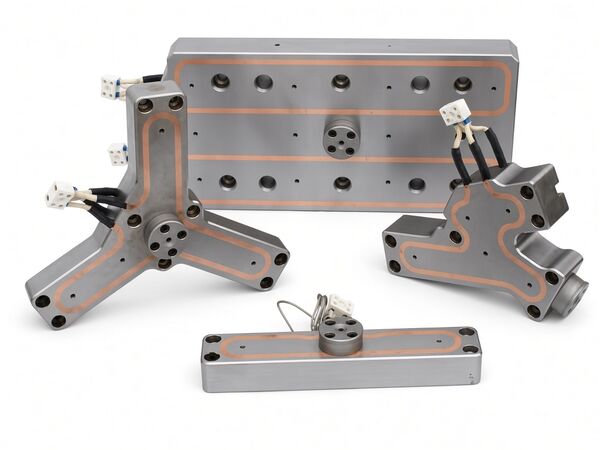
Mica insulated heaters are made by enclosing ribbon resistance wire wound on mica sheet inside a stainless steel sheath. The same construction is offered in two forms: the band form that wraps cylindrical barrels, and the strip (plate) form that is bolted onto flat surfaces. The band form is the most common heater type for the barrels of extrusion and injection moulding machines; its low profile fits into tight installation gaps and transfers heat directly to the barrel surface. The strip form is used to heat flat surfaces such as mould plates, press platens, drying tunnels and sealing jaws.
In the band form, the main factor determining product life is clamping force. A loosely clamped band leaves an air gap between itself and the barrel; the heater cannot transfer heat, accumulates it and the mica insulation carbonises. For this reason we recommend re-tightening the bolts after the first heat-up — clamping force decreases as the metal expands.
Clamping options include hinged clamps, bolted lugs, strap-type tensioners and wire tensioners. If the barrel has a nozzle, sensor or feed opening, cut-outs and holes can be made in the band; the winding continues uninterrupted around the cut-out to prevent cold spots.
In the strip form, heat transfer relies entirely on contact, so the flatness of the mounting surface is decisive. A strip heater mounted on a warped or burred surface only delivers heat at the points it touches; local overheating occurs in non-contact areas and the mica insulation carbonises. We recommend grinding the surface before installation and tightening the bolts gradually from the centre outwards.
Holes, lugs or studs can be provided on the strip body for mounting. Cold zones are left at the ends to prevent the cable exit from overheating. In the strip form a sensor pocket can be machined into the body or a thermostat integrated; in the band form a thermocouple pocket is offered as an option.
Applications
- Extrusion barrels
- Injection barrels
- Pipelines
- Tank walls
- Mould blocks
- Mould plates
- Press platens
- Drying tunnels
- Sealing jaws
- Packaging machines
Related Industries
Frequently Asked Questions
A mica band heater is thinner and more economical and is usually sufficient at moderate temperatures. For higher operating temperatures and applications requiring high watt density, a ceramic insulated band heater is preferred. The right type is determined for each project from the operating temperature and power requirement.
The most common cause is loose clamping. Re-tighten the bolts after the first heat-up. The second most common cause is plastic residue or an oxide layer on the barrel surface; the surface should be cleaned before installation.
No. The strip form is designed for flat surfaces; on a curved surface, the areas without contact overheat locally. For curved surfaces the band form or a flexible silicone heater should be used.
In the strip form, the bolts should be tightened gradually from the centre outwards with equal torque; tightening from one side bends the plate and causes loss of contact. In the band form, the bolts should be re-tightened after the first heat-up.
Related Guides
Related Products
Let us define the right solution for your project together
Contact us to determine the most suitable heater and industrial heating solution for your project. Our technical team is ready to offer the solution that best fits your requirements.