Updated: October 5, 2026
Why does the temperature sensor matter?
A heating element only produces heat; holding the target temperature depends on the control system, which switches power on and off according to the measured value. If the sensor is wrongly selected or wrongly positioned, the system overshoots or undershoots the target, the heater can overheat and product quality suffers.
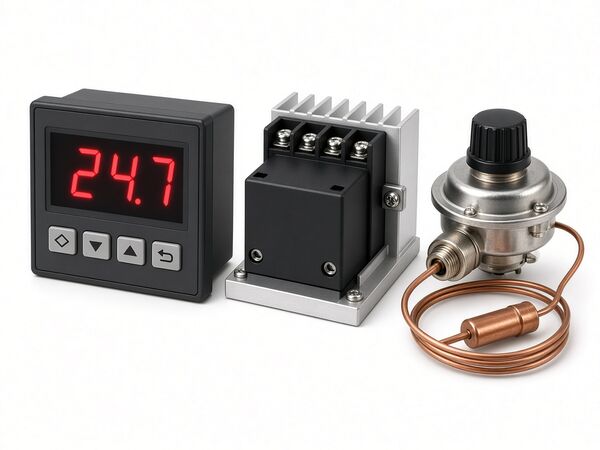
The sensor, heating element and temperature controller should therefore be selected together. The controller input must be configured for the type of sensor used.
What is a thermocouple and how does it work?
A thermocouple consists of two wires of different metals joined at one end. When the junction (measuring tip) is heated, a small voltage proportional to the temperature difference develops between the wires. This is known as the Seebeck effect; the voltage generated is in the millivolt range.
A thermocouple does not measure absolute temperature but the difference between the measuring tip and the reference point where the wires connect to the instrument. Controllers therefore measure the temperature of the reference point separately and apply a correction; this is called cold junction compensation.
The strengths of a thermocouple are its wide temperature range, robust construction, availability in small diameters and fast response. Its weaknesses are lower accuracy than a PT100 under the same conditions and a tendency to drift over time.
Thermocouple types: J, K and others
Thermocouple types are designated by letters according to the metal pair used and are defined in IEC 60584. Those most often encountered in industrial heating are:
- Type J (iron – copper-nickel): An economical type generally used up to around 750 °C and common on plastics processing machinery. The iron wire is prone to rusting in humid environments.
- Type K (nickel-chromium – nickel-aluminium): A general-purpose type used in furnaces and high-temperature applications up to around 1100 °C. It is resistant to oxidising atmospheres.
- Type T (copper – copper-nickel): Preferred for low and sub-zero temperatures.
- Type N: A more stable alternative at high temperature, covering a range close to that of type K.
- Types R, S and B: Costly platinum-rhodium alloy types used for very high temperatures.
The ranges given are general values; the actual limit depends on wire diameter, sheath material and environment. The extension or compensating cable between the thermocouple and the controller must be of the same type as the thermocouple and connected with the correct polarity; a cable of a different type corrupts the measurement. Because cable colour codes differ between standards (such as IEC and ANSI), the type letter rather than the colour should be relied on.
What is a PT100 and how does it work?
A PT100 is a resistance temperature detector (RTD). The electrical resistance of a platinum element increases predictably with temperature: a PT100 has a resistance of 100 Ω at 0 °C, rising to approximately 138.5 Ω at 100 °C. The controller measures this resistance and calculates the temperature. A PT1000 works on the same principle and has a resistance of 1000 Ω at 0 °C.
Accuracy classes for PT100 elements are defined in IEC 60751 (such as AA, A, B and C). Class B and class A are the most common in industry.
The strengths of a PT100 are high accuracy, repeatability and long-term stability. On the other hand, it is more delicate than a thermocouple, more sensitive to vibration and has a narrower operating range. Most industrial applications lie between approximately −50 °C and 400 °C; wider ranges are possible depending on construction.
2, 3 and 4-wire PT100 connection
Because a PT100 measures resistance, the resistance of the connecting leads is added to the measurement. Three connection methods are used to manage this effect:
- 2-wire: The simplest connection; lead resistance translates directly into measurement error. Intended for short leads and low-precision applications.
- 3-wire: Largely compensates for lead resistance; the most common solution in industrial applications.
- 4-wire: Eliminates the effect of lead resistance; used in laboratories and measurements that require high accuracy.
Check which connection the controller supports before ordering the sensor.
Thermocouple or PT100?
The two sensors are not substitutes for each other but answers to different needs. As a general guide:
- High temperature (above approximately 400 °C), furnace and barrel measurement: thermocouple.
- Confined space, small diameter and fast response: fine-diameter thermocouple.
- Precise process control, food and chemical tanks, low temperatures: PT100.
- Environments with vibration and shock: mineral-insulated thermocouple.
- Long cable runs: 3 or 4-wire PT100 or a signal transmitter.
The final choice depends on the measuring range, required accuracy, mounting location and controller.
Sensor construction and installation
Where a sensor measures matters as much as how accurately it measures. The main points to watch in heating applications are:
- Position: The sensor should be placed between the heater and the zone to be controlled. A sensor too close to the heater measures the heater itself; a sensor too far away measures a delayed value.
- Contact: The sensor tip must seat fully in its pocket; an air gap slows the response. Spring-loaded and threaded bodies help maintain contact.
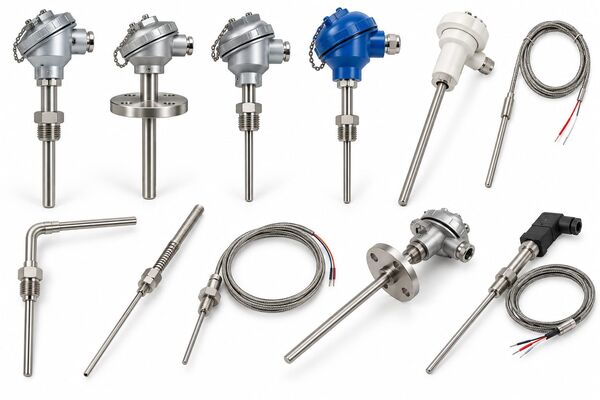
- Body type: Rod, threaded (with compression fitting), spring-loaded bayonet and adhesive surface sensors are selected according to the application.
- Measuring junction: In a thermocouple, a grounded junction responds faster; an ungrounded (insulated) junction is safer against electrical noise and measurement errors caused by earth leakage.
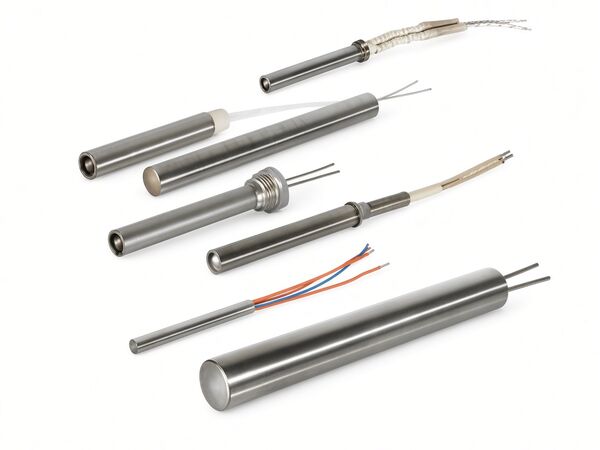
- Integrated sensor: A type J or K thermocouple can be built into some cartridge heaters; this is used to monitor the heater's own temperature.
For product options, see the thermocouples, temperature sensors and connectors page, where you can also request a sensor and control set matched to your heating element.
Sensors age over time. The reading of thermocouples operating continuously at high temperature can drift; in critical processes, periodic comparison checks and keeping a spare sensor are therefore recommended. When a sensor is replaced, fitting one of the same type, diameter and immersion length ensures that the measuring point does not change.
Frequently Asked Questions
Disconnect it and check continuity between the leads; a broken thermocouple shows an open circuit. For measurement accuracy, compare it at a known reference temperature against a calibrator or reference sensor. The measured millivolt value can also be compared with the reference table for its type.
Both are platinum resistance thermometers. A PT100 has a resistance of 100 Ω at 0 °C, a PT1000 1000 Ω. In a PT1000 the effect of lead resistance on the measurement is proportionally smaller; which one to use depends on the input supported by the controller.
The sensor can be changed, but the controller input setting must also be switched to type K. Types J and K generate different voltages at the same temperature; if the setting is not changed, the instrument will display the wrong temperature. The compensating cable must also suit the new type.