Updated: October 5, 2026
Cartridge heater construction
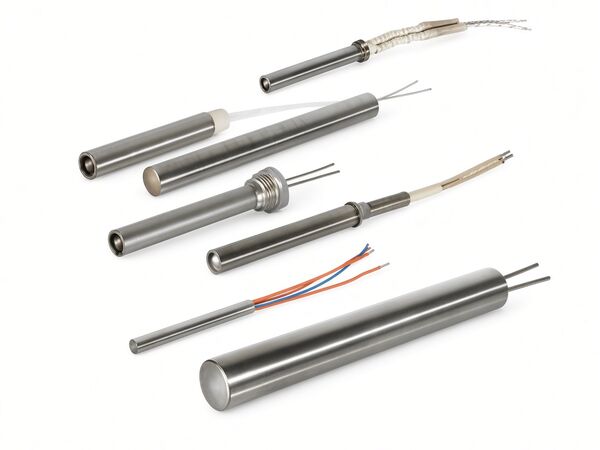
A cartridge heater consists of nickel-chromium resistance wire wound on a ceramic core, compacted magnesium oxide (MgO) filling that insulates the wire from the sheath, and a stainless steel or Alloy 800 series sheath. Compaction lets heat pass quickly from the wire to the sheath and is what allows the element to operate at high watt density.
In applications such as moulds, hot runners, packaging jaws, laboratory blocks and dosing units, it heats from inside the metal mass, close to where the heat is needed. In Türkiye it is commonly called "fişek rezistans"; in international literature it is known as the cartridge heater.
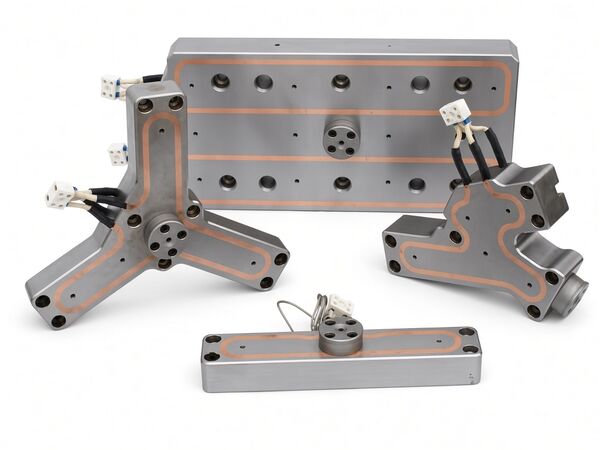
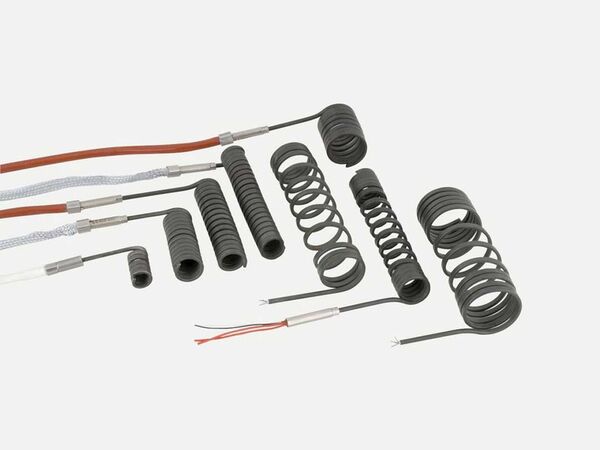
In hot runner systems, a manifold heater for the manifold block and coil heaters for the nozzles are used alongside cartridge heaters. These products belong to the mould and barrel heaters family.
What is watt density and how is it calculated?
Watt density is the power a heater delivers per unit of surface area and is expressed in W/cm². The calculation uses the heated surface area:
Watt density (W/cm²) = Power (W) ÷ (π × Diameter (cm) × Heated length (cm))
For example, for a 500 W cartridge heater of Ø10 mm diameter and 100 mm length with a heated length of approximately 90 mm, the surface area is π × 1.0 × 9.0 ≈ 28.3 cm² and the watt density is approximately 17.7 W/cm².
Delivering the same power at a higher watt density means using a smaller heater, but the element runs hotter. The permissible watt density is determined by the following factors:
- Block temperature: The higher the target temperature, the lower the permissible watt density.
- Bore clearance: A tight fit allows a high watt density; a loose fit does not.
- Block material: Aluminium and copper draw heat away faster than steel.
- Duty cycle: Frequent on-off cycling or vibration places additional stress on the element.
The appropriate value is selected by considering these parameters together; no single figure suits every application.
Total power, on the other hand, is calculated from the mass of the block, the specific heat of the material, the required heat-up time and the heat losses during operation. If the required power cannot be delivered by a single cartridge heater, it is split across several heaters distributed evenly in the block; this approach both lowers the watt density and improves the temperature distribution.
Diameter tolerance and bore clearance
The most important factor determining the performance of a cartridge heater is the contact between the heater and its bore. Heat passes from the heater sheath into the metal block by conduction; any air gap in between behaves like an insulator. As the gap grows, the heater cannot transfer the heat it produces to the block, its internal temperature rises and the resistance wire fails early.
For this reason, cartridge heaters are manufactured to a tight diameter tolerance, and the bore must also be machined to a precise tolerance. Common industry practice is to ream the bore after drilling and to keep the diametral clearance between heater and bore as small as possible. Exact tolerances are determined at the quotation stage according to heater diameter and application.
When fitting a new heater into an old or worn bore, always measure the bore diameter. If it has grown, a heater of the same nominal diameter will sit loosely; in that case the bore should be corrected or a suitable diameter chosen.
Heated length, unheated zones and distributed winding
Not all of a cartridge heater produces heat. At the lead exit end and at the tip there are unheated zones (cold zones) where no resistance wire is wound. The cold zone at the lead exit prevents the connection and cable from overheating; it can be extended if the heater protrudes from the block.
The edges of a block lose more heat to the surroundings. As a result, a uniformly wound heater can keep the centre of the block hotter than its edges. With distributed (profiled) winding, the wire pitch is tightened towards the ends so that more power is delivered where losses are high, giving a more even temperature along the block.
Lead exit and connection options
The leads and connection are the most frequently damaged part of a heater. They are selected according to ambient temperature, movement and vibration, and contact with liquids or oil:
- Lead insulation: Silicone cable is a flexible solution at low and moderate temperatures; fibreglass-insulated leads withstand higher temperatures.
- Mechanical protection: Metal braid or spiral conduit protection is used in areas with movement or sharp edges.
- Exit direction: Axial (straight), radial (90°) or angled exit is selected according to the available mounting space.
- Mounting hardware: Cartridge heaters with a threaded fitting are secured by a screw connection; flanged types are bolted to the block.
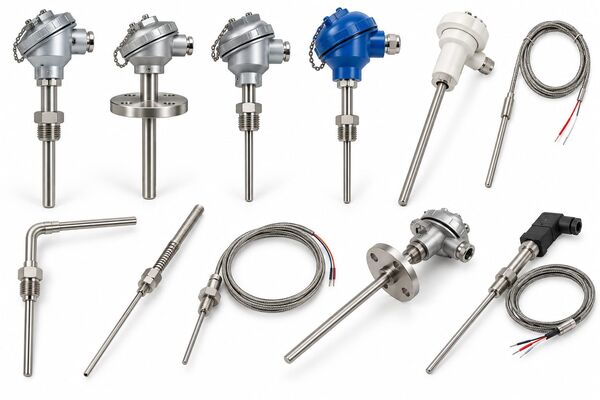
- Sensor: Cartridge heaters with a built-in type J or K thermocouple make it possible to monitor the heater's own temperature; a separate thermocouple or PT100 sensor is used for the block temperature. For details, see the thermocouple and PT100 guide.
On the voltage side, 230 V and 400 V are common; low-voltage cartridge heaters such as 12 V or 24 V are also used in machinery and automation applications. Because power and voltage together determine the resistance value, both should be specified when ordering.
Installation and first start-up
- Clean the bore: Swarf, oil and residue impair heat transfer.
- Use high-temperature anti-seize compound where needed: It reduces seizure caused by oxidation and makes removal easier.
- Drill a through-hole where possible: Being able to push the heater out from behind the bore makes removing a seized heater much easier.
- Do not strain the leads: The lead exit should not be bent sharply, should be kept away from moving parts and should be secured where necessary.
- Check for moisture: The MgO filling can absorb moisture over time. The insulation resistance of heaters that have been in storage for a long time or kept in a humid environment should be measured before start-up and, if necessary, they should be dried out at low power.
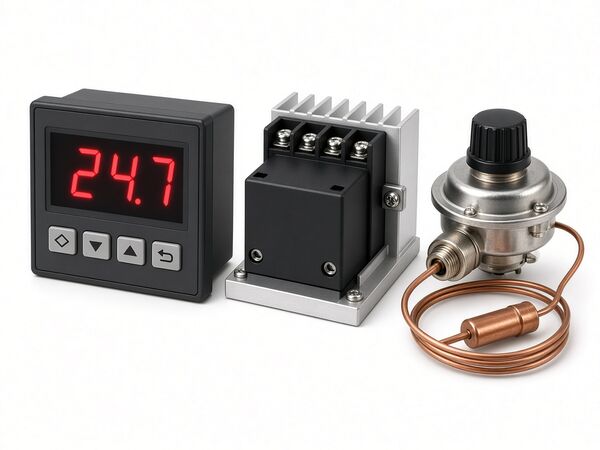
- Use temperature control: Control with a PID controller and a solid-state relay (SSR) reduces fluctuations in element temperature compared with on-off control.
Information required for ordering
To specify the right cartridge heater, the following information is sufficient:
- Diameter and overall length (mm).
- Power (W) and voltage (V).
- Lead exit type, lead length and lead protection.
- Mounting hardware required (threaded fitting, flange) and, if applicable, the type of integrated thermocouple.
- Block material, operating temperature and bore size.
- Quantity and expected repeat orders.
If information is missing, an assessment can also be made from a sample or a photograph. You can attach your technical drawing via the quotation form.
Frequently Asked Questions
The most common cause is bore clearance: when air remains between the heater and the hole, heat cannot pass into the block and the resistance wire overheats. A watt density set too high for the application, liquid or oil entering the lead exit and uncontrolled operation also shorten service life.
No, they are two names for the same product. "Fişek rezistans" is the common name in Türkiye, while "cartridge heater" is the name used in international sources.
Seizure can occur due to oxidation at high temperature. In a through-hole bore, the heater is pushed out from behind with a suitable pin. In a blind hole, pulling it out by force can tear off the leads; this is why using anti-seize compound and, where possible, designing a through-hole are recommended.