Updated: October 5, 2026
What is a heating element?
In electrical engineering, resistance is the opposition a conductor offers to current, and in electronics a resistor is the component that provides it. In industry, a resistance heater or heating element usually means an electric heating element: a part made up of a resistance wire that heats up when current flows through it, and a body that protects the wire and carries the heat to the target.
The elements that heat the barrel of a plastic injection moulding machine, the liquid in a chemical bath, the air in a drying oven or the jaws of a packaging machine all fall under this definition. What sets them apart is where, and how, they transfer the heat.
How does a heating element work?
The working principle is based on the Joule effect: when current flows through a conductor with resistance, electrical energy is converted into heat. The power of a heating element is determined by the applied voltage and the resistance of the wire (P = V² / R). For example, an element rated at 1000 W at 230 V has a resistance of approximately 53 Ω.
In practice, the conversion of electrical energy into heat is lossless. What really determines the efficiency of a heating system is how well the heat produced is transferred to the target material. Contact surface, insulation and installation are therefore as important as the power rating.
Heat is transferred in three ways, and heating element types are largely distinguished by these:
- Conduction: The element is in contact with the metal part to be heated. Cartridge, band and cast-in heaters belong to this group.
- Convection: The element sits in or in the path of a fluid such as water, oil or air. Tubular, flanged and finned heaters belong to this group.
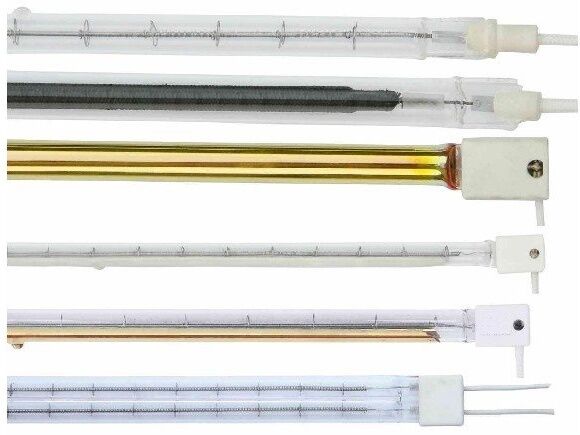
- Radiation: Heat is transferred without contact, by infrared waves. Quartz and ceramic infrared heaters belong to this group.
What is a heating element made of?
Whatever the type, a heating element has three basic components:
- Resistance wire: Usually a nickel-chromium (NiCr 80/20) alloy. The alloy determines the maximum operating temperature and the service life.
- Electrical insulation: It must isolate the wire from the sheath while letting heat pass through. Tubular elements use compacted magnesium oxide (MgO) powder; band heaters use mica or ceramic.
- Sheath (body): The outer part that carries heat to the target and protects the wire from the environment. It may be stainless steel (AISI 304, 316, 321), Alloy 800 series, copper, titanium, quartz glass or silicone rubber.
Mounting parts such as cables, terminals, compression fittings or flanges are added to these. Designing an application-specific heating element is, in essence, choosing the right combination of these components.
Types of industrial heating elements
By form and place of use, industrial heating elements fall into the following main groups:
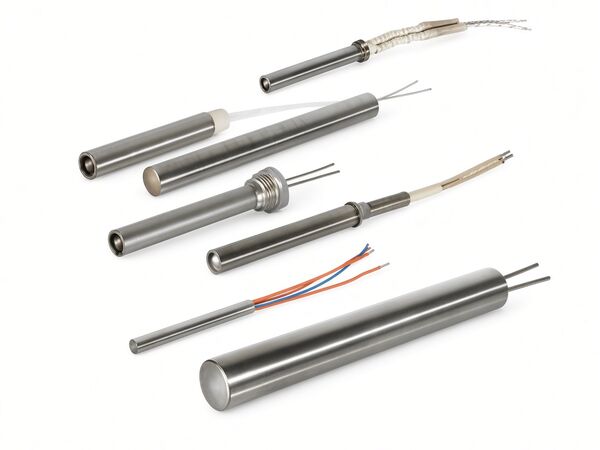
- Cartridge heater: A cylindrical element inserted into a hole drilled in a metal block. It provides localised heating at high watt density in moulds, hot runners and packaging jaws.
- Band heater: An element that wraps around a cylindrical surface from the outside. Mica insulated types are used at moderate temperatures and ceramic insulated types at higher temperatures, on the barrels of plastics machinery.
- Coil heater and nozzle heater: Compact elements for small-diameter parts such as injection nozzles and hot runner nozzles.
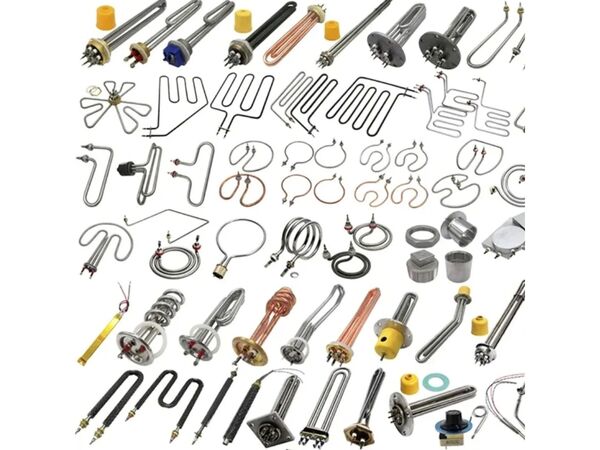
- Tubular heater: A resistance wire inside an MgO-filled metal tube. Straight or bent to the required shape, it is the most common type, used for heating liquids, air and moulds.
- Flanged heater and tank heaters: Immersion heaters in which several tubular elements are grouped on a flange or screw plug and mounted in tanks and boilers.
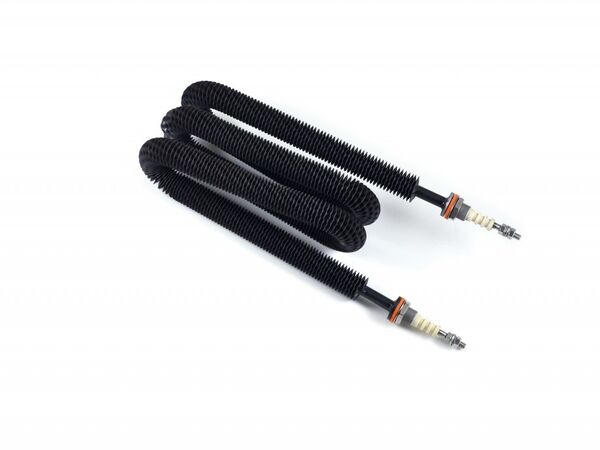
- Finned tubular heater: A tubular element with a metal fin wound around it. It heats air in air ducts and drying ovens.
- Quartz and ceramic infrared heaters: They transfer heat by radiation and are used for paint drying, thermoforming and surface heating.
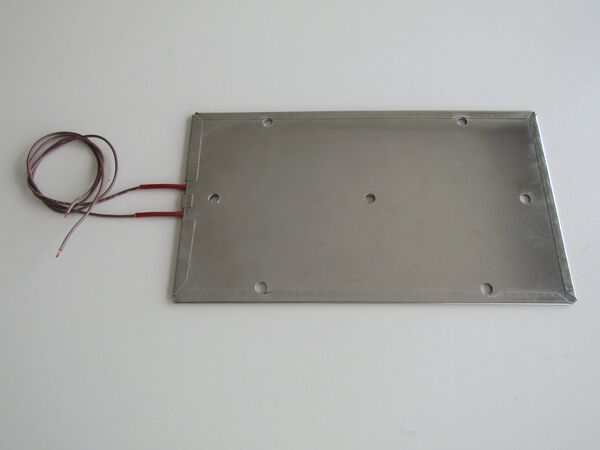
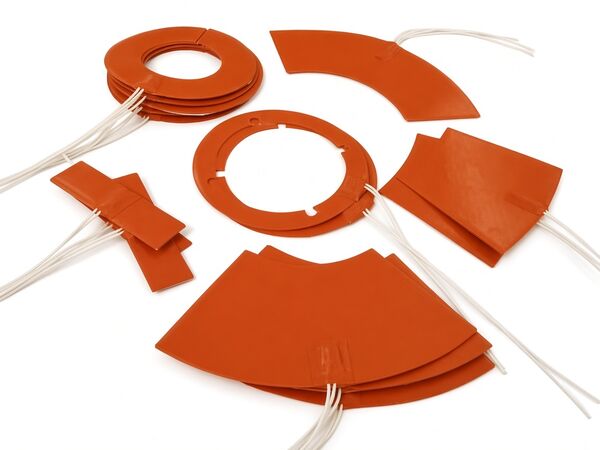
- Silicone rubber heaters and heating cables and tapes: Thanks to their flexibility, they are wrapped around or bonded to drums, pipelines and irregular surfaces.
- Silicon carbide and MoSi₂ elements: Ceramic heating elements used in high-temperature furnaces beyond the limits of metal wires.
- Explosion-proof heaters: Heater assemblies for explosive gas or dust atmospheres, designed so as not to become a source of ignition.
Alongside the heater, the thermocouples and PT100 sensors that measure temperature and the temperature controllers that switch the heater on and off are also part of the system. For applications that do not fit standard forms, custom heating elements are manufactured.
Our product range is grouped into six families along these lines: mould and barrel heaters, liquid, tank and process heaters, air and space heating systems, quartz infrared heaters, heating cables and flex surface heaters and control, measurement and sensors.
Where are industrial heating elements used?
Because electric heating is clean, precisely controllable and can be installed at the point of use, it is preferred across many industries:
- Plastics processing: Injection moulding and extrusion barrels, nozzles, hot runner systems and moulds.
- Packaging machinery: Sealing and cutting jaws, shrink tunnels.
- Food processing machinery: Ovens, cooking lines and liquid heating tanks.
- Chemical and process: Chemical baths, reactor and tank heating, corrosive liquids.
- Energy and boiler systems: Electric boilers, steam and thermal oil systems.
- Textiles and HVAC: Drying lines, air handling units and air ducts.
What information is needed to select a heating element?
To specify the right heating element, the application must be defined before the product name. The technical assessment asks for the following information:
- What is to be heated: a metal block, a liquid (its type and chemical composition), air or a surface.
- Target temperature and required heat-up time.
- Mounting geometry and dimensions: bore diameter, barrel diameter, tank size, duct cross-section.
- Power and voltage: total power, supply voltage, number of phases.
- Ambient conditions: humidity, corrosion, vibration, explosive atmosphere.
- Connection and control: cable exit, terminal box, sensor requirement.
Once this information is clear, the sheath material, insulation and watt density are selected together. Watt density, the power delivered per unit of surface area, is the parameter that most affects heater life. Spreading the same power over a larger surface lowers the element temperature and extends its life.
For detailed selection criteria, see the guides on cartridge heater selection, finned tubular heaters and thermocouples and PT100, and for explosive atmospheres the explosion-proof and ATEX guide.
What determines the life of a heating element?
Heating elements mostly fail because the resistance wire overheats or the sheath corrodes. The most common causes in the field are:
- Loose fit: A gap left around a cartridge heater in its bore, or a band heater that does not fully wrap the barrel, prevents heat from leaving the element.
- Watt density unsuited to the fluid: In oil and viscous liquids, a high surface load leads to carbonisation and overheating.
- Dry firing: An immersion heater running in air when the liquid level drops.
- Wrong sheath material: The sheath being perforated in a corrosive environment.
- Moisture: When the MgO filling absorbs moisture, insulation resistance drops. Elements that have been in storage for a long time should be checked before first start-up.
- Uncontrolled operation: Running without a temperature sensor, or with a poorly positioned one.
Frequently Asked Questions
The resistance wire is usually a nickel-chromium (NiCr) alloy. The wire is insulated with magnesium oxide, mica or ceramic and placed inside a sheath such as stainless steel, Alloy 800 series, copper, titanium, quartz or silicone. Materials are selected according to the operating temperature and environment.
In all heating element types, the conversion of electrical energy into heat is almost complete. Differences in efficiency come from how the heat is transferred to the target: a tight-fitting cartridge heater in a metal block, an immersion type in a liquid and a radiant heater for surface heating at a distance give the best results. The right type depends on the application.
In everyday use the two terms are often used interchangeably. A heating element usually refers to the element itself, whereas a heater refers to the complete system made up of the element and parts such as the housing, connections, fan or controls.